Looking at the voyager image taken from the edge of solar system, Carl Sagan once reflected:
Video from the Cosmos by: Carl Sagan
Peace!

Stephen Hawking is perhaps the world's most famous living physicist. A specialist in cosmology and quantum gravity and a devotee of black holes, his work has probed the origins of the cosmos, the nature of time and the universe's ultimate fate -- earning him accolades including induction into the Order of the British Empire. To the public, he's best known as an author of bestsellers such as The Universe in a Nutshell and A Brief History of Time, which have brought an appreciation of theoretical physics to millions.
Though the motor neuron disorder ALS has confined Hawking to a wheelchair, it hasn't stopped him from lecturing widely, making appearances on television shows such as Star Trek: The Next Generation and The Simpsons -- and planning a trip into orbit with Richard Branson's Virgin Galactic. (He recently experienced weightlessness aboard Zero Gravity Corporation's "Vomit Comet.") A true academic celebrity, he uses his public appearances to raise awareness about potential global disasters -- such as global warming -- and to speak out for the future of humanity: "Getting a portion of the human race permanently off the planet is imperative for our future as a species," he says.
Hawking serves as Lucasian Professor of Mathematics at the University of Cambridge, where he continues to contribute to both high-level physics and the popular understanding of our universe.
"We are just an advanced breed of monkeys on a minor planet of a very average star. But we can understand the Universe. That makes us something very special."Stephen Hawking
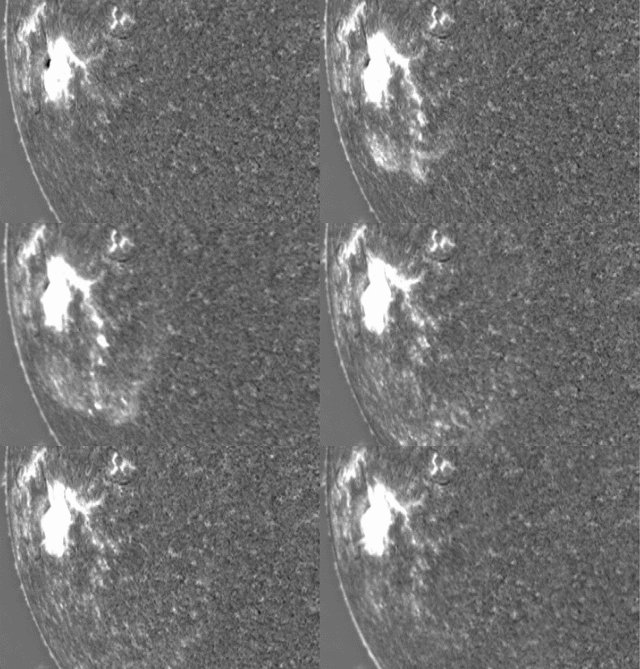
It was glimpsed by Nasa’s STEREO spacecraft . STEREO mission consist of two spacecrafts revolving around the Sun to reveal it's 3D image.
Tsunami on the Sun is a wave of pressure that sweeps across the Sun. It is induced by a huge explosion near or on the surface of the Sun, such as a coronal mass ejection or flare, which causes a pressure to propagate outwards in a circular pattern.

I’d like to thank Nabin for providing me another opportunity to write in his blog.
The other day it was announced that Al Gore, along with the United Nations Climate Control Panel, won the Nobel Peace Prize for their combined efforts to raise international awareness of climate change caused by man-made greenhouse gas emissions. I commend this choice for the award because the sooner we acknowledge that the problem exists, and that it is not in fact a natural phenomenon, then the sooner we can start taking measures to address the problem
So that raises the question of what measures should be taken to address global warming. A popular choice is a carbon trading system, which I believe, though good intentioned, will ultimately produce little beneficial results while lulling the public into a false belief that the problem of global warming is being addressed. To explain what I mean, let’s first consider some numbers.
Roughly 28 billion tonnes (metric) of Carbon Dioxide were released into the atmosphere by man-made processes. Within two years the worldwide CO2 emmissions are expected to reach 30 billion tonnes, with China, the U.S., and Europe combined responsible for over 50% of those emissions. Natural processes emit and absorb roughly ten times (200 billion tonnes) that amount of carbon during the carbon cycle which includes respiration, decomposition, absorption and emission from oceans, etc. Often critics of man-made global warming will argue that since man-made emissions are less than 10% than emissions due to natural processes, and that the current warming trend couldn’t thus be caused by man. This argument fails to realize however that natural emissions were in equilibrium with natural absorption in the carbon cycle before man-made contributions began, which means that the 28 billion tonnes is not in addition to that which is released by nature but in fact a perturbation to the natural equilibrium position.
In that light, a 10% perturbation to equilibrium is in fact a massive effect on the natural equilibrium. Nature of course will try to adjust as can be seen by the slight increase in the pH of the oceans as more CO2 is absorbed as well as a “greening effect” where fauna actually become denser per square mile. Unfortunately man is fighting that equilibrium response by systematic deforestation (Brazil, Ukraine, Canada, US, etc). Also, the warming temperatures are slowly extending the temperate regions, significantly increasing the land in which plant life can grow, but at the same time releasing CO2 that has been locked up in frozen tundra and glaciers for thousands of. Additionally, as highly reflective ice recedes leaving more absorptive (blacker) ground in its wake, more power from the Sun is converted to into infrared radiation which can be captured by the CO2. To put it simply and bluntly, the very speed at which temperature levels are rising, coupled with human deforestation is severely limiting the Earths natural equilibrium response. This can be seen by 20% CO2 content increase in the atmosphere over the last 50 years (315 ppm to 380 ppm).
The carbon trading system proposes creating a market where carbon credits (papers permitting X amount of emissions) are exchanged towards a global goal of reducing carbon emissions by half in the next 50 years or so. Of course they draw pretty graphs that show global temperature increase tapering off at different slopes depending upon the rate of the reduction of carbon emissions over the next 50 years. These graphs are a joke because they basically assume little or no change in the natural carbon emissions and absorptions after a dramatic climate shift. The reality is that such a trading system will not reduce atmospheric carbon levels (which is causing the warming), but in fact slow the rate at which they are increasing. In other words, if the entire world cooperates and agrees to a carbon trading system, and there is no corruption or fraud, then in 2050 the carbon dioxide content of air will be 450ppm instead of 500ppm as compared to the 380ppm of today. Not exactly a solution is it?
But maybe 450ppm isn’t so bad right? I mean, here we are at 380ppm and Earth isn’t so bad. If only it were that simple. CO2 levels haven’t exceeded 300ppm in the last 500,000 years. We are talking about being roughly 25% beyond the peak right now. That means more heat than ever in the past half million years is being captured by the Earths surface atmosphere. So where is it all going? The excess heat is being absorbed by the oceans. You see, water has a heat capacity that is 4 times larger than land, and since most of the Earth’s surface is water (70%), it tends to soak up all this extra heat, slowly increasing in temperature. If you think of CO2 levels as a force and the velocity as increasing global temperatures and natural absorption processes as a form of friction resisting this increase in temperatures, then the heat capacity of the oceans is like a big heavy mass that takes a lot of force to move. So although the Earth doesn’t seem to be changing much in temperature, a massive inertia is building that will be hard to reverse. With such an inertia, a small reduction in the increase in CO2 levels will be meaningless. Drastic action must be taken in order to slow temperature increases in any meaningful way.
What needs to happen, and what no one wants to hear, is that we need an immediate elimination of greenhouse emissions along with the elimination of deforestation. Only then will the climbing global temperatures start to taper off like they do in those nice graphs the carbon trading system people like to show. Is that practical? Perhaps if we had a way to generate energy cheaply that didn’t emit CO2, but seeing as we have nothing like that at this time, I suggest you all get used to the warming weather, its here to stay. The carbon trading system is only a placebo, we’ll feel good for a while, but it won’t actually be doing anything.
**************************************************
Roger Pink is {my friend :) } a Ph.D. student at the Department of Physics, University at Albany, State University of New York.
He is associated with the cr4 and has been regular blogger there since early 2005: http://cr4.globalspec.com/blog/browse/6/Roger-s-Equations
His previous entry is here
Read the rest of this article:
http://en.wikipedia.org/wiki/Intelligent_design
_______________________________
Today's selected anniversaries:
1492:
Christopher Columbus made landfall in the Caribbean, believing he
had reached East Asia.
(http://en.wikipedia.org/wiki/Christopher_Columbus)
1915:
A German firing squad executed British nurse Edith Cavell for
helping Allied soldiers to escape occupied Belgium.
(http://en.wikipedia.org/wiki/Edith_Cavell)
1928:
An iron lung medical ventilator, designed by Philip Drinker and
colleagues at Children's Hospital, Boston, was used for the first time
in the treatment of polio victims.
(http://en.wikipedia.org/wiki/iron_lung)
1984:
The Provisional Irish Republican Army failed in its attempt to
assassinate British Prime Minister Margaret Thatcher and most of her
cabinet in the Brighton hotel bombing.
(http://en.wikipedia.org/wiki/Brighton_hotel_bombing)
2002:
A series of bombs exploded in Bali, Indonesia, killing 202 people
and injuring a further 209.
(http://en.wikipedia.org/wiki/2002_Bali_bombings)
_____________________
Wiktionary's Word of the day:
jaded: Worn out, wearied, or lacking enthusiasm; exhausted.
(http://en.wiktionary.org/wiki/jaded)
_____________________
Wikiquote of the day:
Everything abstract is ultimately part of the concrete. Everything
inanimate finally serves the living. That is why every activity
dealing in abstraction stands in ultimate service to a living whole.
-- Edith Stein
(http://en.wikiquote.org/wiki/Edith_Stein)